Affiliate disclosure: This article contains affiliate links to eBay. As a participant in the eBay Partner Network, GrailStitch may earn a commission if you click a link and make a purchase, at no extra cost to you.
How to Date Vintage 1970s Nike Sneakers: Orange Swoosh Tags, Pinwheel Logos, and Waffle Soles
By GrailStitch Editorial, published , 5 min read
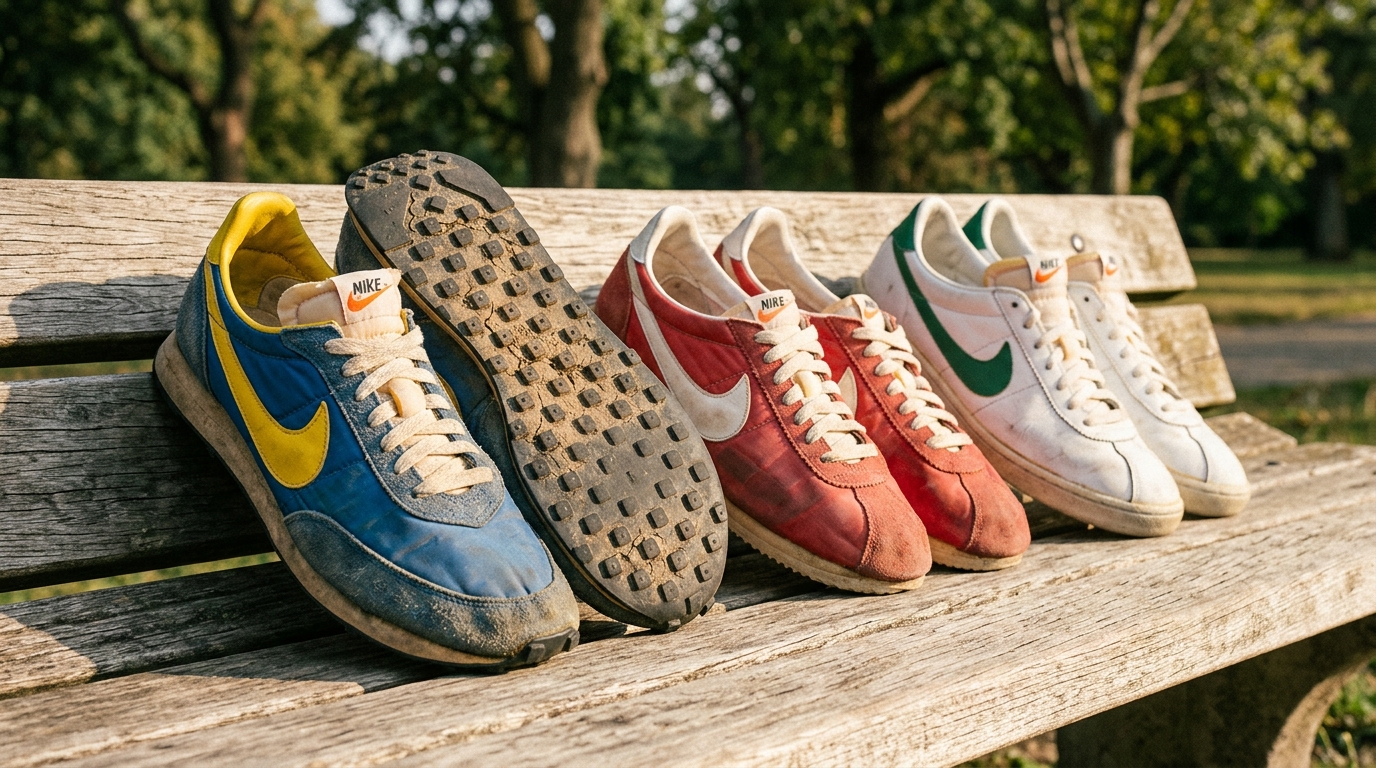
Before Nike became a global sportswear giant in the 1980s, its 1970s footwear—originally distributed under the Blue Ribbon Sports (BRS) banner—was built in small batches across Japan, Taiwan, Korea, and early American workshops in New Hampshire and Maine. Because 1970s Nike runners and court shoes routinely command four-figure prices on the collector market, learning how to read tongue tags, heel tabs, and sole rubber is essential before buying—especially when separating true 1970s originals from modern "Vintage Series" reissues.
Quick Reference Matrix: 1970s Nike Eras & Identification Clues
Use this comparison table to match tongue tags, heel lettering, and manufacturing origins to their exact 1970s production era:
| Nike Era | Production Years | Tongue Tag Style | Heel Tab Font | Primary Countries of Origin | Typical eBay Value (Wearable / Display) |
|---|---|---|---|---|---|
| Blue Ribbon Sports / Block | 1972 – 1974 | Uppercase block NIKE (no Swoosh) or BRS | Blank or lowercase nike | Japan | $800 – $3,000+ |
| Orange Swoosh Era | 1974 – 1978 | White woven tag with Orange Swoosh + italic nike | Lowercase cursive nike | Japan, Taiwan, Korea | $400 – $1,500+ |
| Pinwheel Promotional | 1978 – 1979 | Circular 8-Swoosh Pinwheel logo | Lowercase nike or block NIKE | USA, Taiwan, Korea | $600 – $2,000+ |
| Late-70s Transition | 1978 – 1980 | Orange Swoosh or early Red Swoosh tag | Bold uppercase NIKE | Taiwan, Korea, USA | $250 – $750 |
1. Decode the 1970s Tongue Labels (Block Text vs. Orange Swoosh)
The woven label stitched onto the top of the tongue is the fastest way to narrow down a pair’s exact production window:
- 1972–1974 (Block Lettering / "Blue Ribbon Sports"): The earliest Nike shoes feature uppercase block NIKE lettering (often in blue, black, or red ink on a white nylon tag) without a Swoosh, or explicitly mention Blue Ribbon Sports on the insole or box.
- 1974–1978 (The "Orange Swoosh" Era): In the mid-1970s, Nike introduced its iconic woven white tongue label featuring a bold orange Swoosh with lowercase cursive/italic nike lettering overlapping it. Pairs with this tag—such as early LDV, Oregon Waffle, and Waffle Trainer runners—are among the most sought-after vintage sneakers ever made.
- Late 1970s (The "Pinwheel" Logo): Used on select 1978–1979 track and promotional models, the circular logo formed by eight interlocking Swooshes (nicknamed the Pinwheel) is an instant hallmark of late-1970s Nike heritage.
2. Inspect the Heel Tab: Lowercase vs. Uppercase Font
Turning a 1970s Nike sneaker around reveals another reliable dating clue printed or stitched onto the leather heel tab:
- Early-to-Mid 1970s: The heel tab displays lowercase
nikelettering (matching the cursive font on the orange Swoosh tongue tag) or sits completely blank on the earliest 1972–1973 Japanese-made pairs. - 1978–1979 Transition: Nike gradually shifted to bold, all-caps
NIKEblock lettering on the heel tab—a style that carried over into the early 1980s. If a shoe has an orange Swoosh tongue tag paired with a lowercase heel tab, you are looking at a true pre-1978 pair.
3. Country of Origin Stamps & Spotting Modern "VNTG" Reissues
Unlike modern sneakers made in Vietnam or Indonesia, 1970s Nike production was concentrated in a handful of early factories:
- Made in Japan (1972–1976): Produced through Nike’s early partnership with Onitsuka/Nippon Rubber. Japanese-made pairs (such as early Leather Cortez and Bruin models) feature tighter stitching, thicker full-grain leather, and printed size stamps directly on the inside collar lining rather than a sewn size tag.
- Made in Taiwan & Korea (Mid-to-Late 1970s): Look for stamped ink size codes (often including a two-digit year code like
77or78followed by factory letters such asTHorPS) printed along the inner ankle collar. - Made in U.S.A. (Late 1970s): Domestic pairs built in Exeter, New Hampshire, or Saco, Maine—such as the Yankee or Bermuda—are prized by collectors for their distinct American last shapes and suede quality.
- Watch Out for 2007–2020s "VNTG" Reissues: Nike frequently re-releases 1970s silhouettes (like the Blazer and Waffle Trainer) with pre-yellowed midsoles and retro orange Swoosh tags. Always check the inside collar: modern reissues have a heat-pressed white size tag with a barcode and 9-digit SKU code (e.g.,
316604-471), whereas true 1970s pairs have stamped ink numbers directly on the lining.
4. Check the Midsole Foam and Waffle Rubber Condition
Buying 50-year-old footwear requires careful physical inspection, as vintage rubber and EVA foam age very differently depending on storage climate:
- EVA Foam Hardening: Unlike 1980s polyurethane midsoles (which crumble into dust via hydrolysis), 1970s Nike runners used layered EVA foam midsoles. Over decades, EVA can compress, dry out, or separate from the upper—requiring careful re-gluing if you intend to display or gently wear them.
- Crystallized Waffle Outsoles: Bill Bowerman’s famous waffle-iron rubber outsole can turn brittle or "crystallized" if stored in hot attics. Always ask sellers whether the rubber tread still has slight flex or if it has hardened like plastic.
Quick 1970s Nike Authentication Checklist
- Read the Tongue Tag: Confirm an orange Swoosh label, early block text, or Pinwheel logo rather than the 1980s red-and-white Swoosh tag.
- Rule Out Modern Reissues: Verify that the inside collar has stamped ink size/year codes—never a modern heat-pressed tag with a barcode or SKU number.
- Check the Heel Tab: Lowercase
nikescript confirms a mid-1970s build; uppercaseNIKEpoints to 1978 or later. - Verify Materials: Authentic 1970s nylon runners use lightweight, slightly glossy nylon paired with long-nap suede overlays—never thick synthetic mesh.
- Assess Sole Flexibility: Ensure the EVA midsole hasn't completely detached and that the rubber outsole isn't cracked or petrified.
Disclosure reminder: Links marked “Check Current Prices on eBay” are affiliate links. Prices and availability change, so confirm details on the listing.