Affiliate disclosure: This article contains affiliate links to eBay. As a participant in the eBay Partner Network, GrailStitch may earn a commission if you click a link and make a purchase, at no extra cost to you.
How to Date Vintage 1980s Champion Reverse Weave Sweatshirts: Tricolor Tags, Side Gussets, and Fit
By GrailStitch Editorial, published , 5 min read
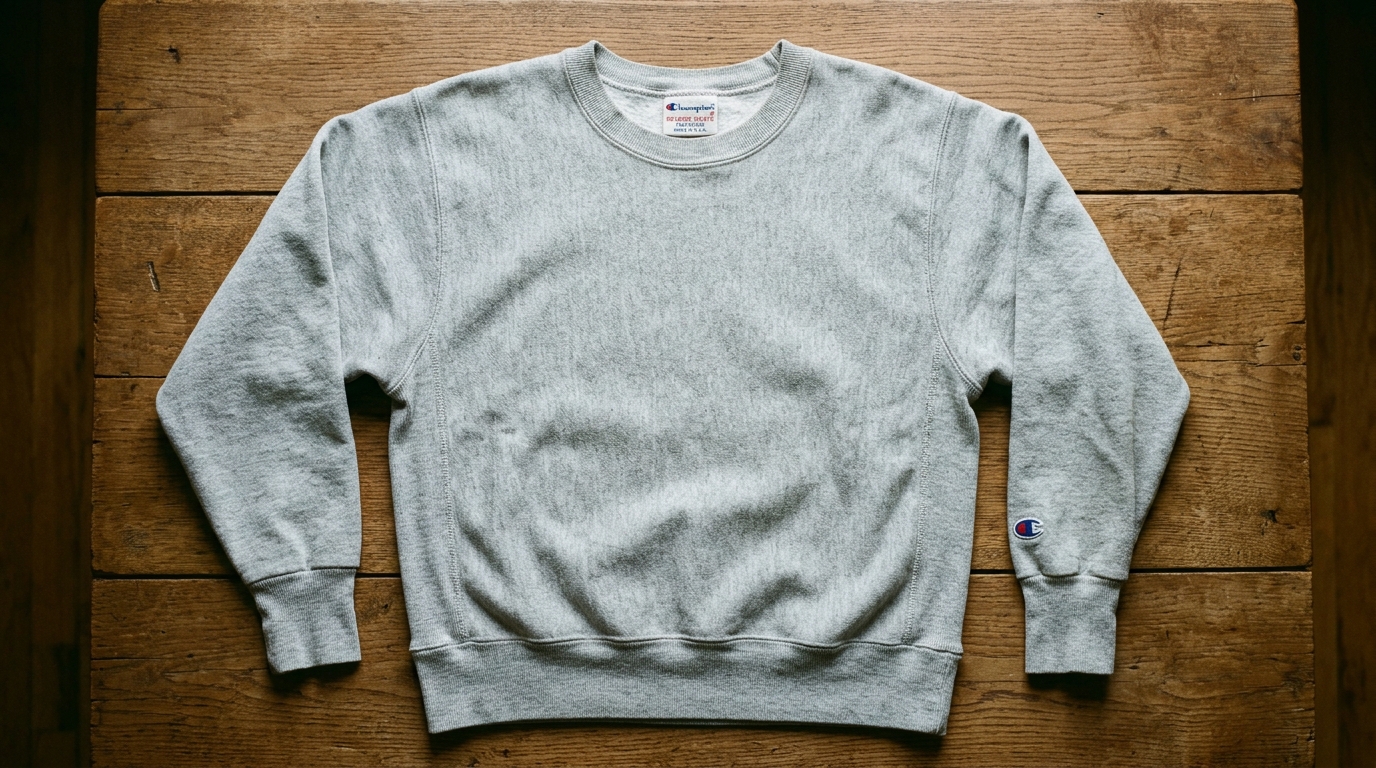
Few pieces of 1980s American sportswear have aged as well as the Champion Reverse Weave sweatshirt. Engineered originally for college athletic departments to prevent vertical shrinkage in industrial laundry machines, 1980s Reverse Weave hoodies and crewnecks command strong prices on the vintage market—provided you know how to distinguish true 1980s Made in U.S.A. pieces from 1990s embroidered-script tags and modern "True to Archives" reproductions.
Quick Reference Matrix: 1980s Champion Reverse Weave Neck Tags
Use this comparison table to match the neck label, construction style, and fabric blend to its exact production era:
| Tag Era Name | Active Years | Visual Tag Details | Typical Fabric Blend | Country of Origin | Typical eBay Value (College / Plain) |
|---|---|---|---|---|---|
| Blue Bar Tag | 1970s – 1981 | White label with solid blue bar behind Champion | 89% Cotton / 8% Acrylic / 3% Rayon | Made in U.S.A. | $180 – $450+ |
| Printed Tricolor Tag | 1981 – 1983 | Red/white/blue tag with ink-stamped care text | 89/8/3 (Grey) or 90/10 (Solids) | Made in U.S.A. | $150 – $380 |
| Woven Tricolor Tag | 1983 – 1989 | Red/white/blue tag with stitched lettering (RN 26094) |
89/8/3 (Grey) or 90/10 (Solids) | Made in U.S.A. | $110 – $300 |
| Embroidered Script Tag | 1989 – 1990s | White tag with stitched cursive Champion script | 89/8/3 or 90% Cotton / 10% Poly | USA (early) / Mexico (late 90s) | $75 – $180 |
1. Decode the 1980s Neck Labels (Blue Bar vs. Tricolor Tag)
Champion updated its woven neck tags several times during the 1980s, giving collectors a reliable timeline:
- 1970s–1981 (The "Blue Bar" Tag): Features a white background with a solid blue horizontal bar behind the word Champion in white lettering, accompanied by
"REVERSE WEAVE WARMUP"and"MADE IN U.S.A."in crisp red or blue print. - 1981–1983 (Early "Printed" Tricolor Tag): In 1981, Champion introduced its famous red, white, and blue Tricolor Tag. The earliest 1981–1983 versions feature printed (ink-stamped) care instructions and size markings directly on the smooth nylon-acetate label.
- 1983–1989 (Woven Tricolor Tag): By 1983–1984, Champion switched to a woven red, white, and blue Tricolor Tag with stitched lettering (
MADE IN U.S.A., fabric blend percentages, andRN 26094). Finding a clean woven Tricolor Tag is the textbook hallmark of a mid-to-late 1980s piece. - Watch Out for "True to Archives" Reissues: Champion’s Japanese heritage line (True to Archives) produces exact replicas of 1970s Blue Bar and 1980s Tricolor tags. Modern replicas always have an extra Japanese care tag sewn inside the lower left side seam and lack the natural yellowing or softening of a 40-year-old neck label.
2. Inspect the Reverse Weave Construction & Side Gussets
Champion patented its Reverse Weave method in 1938 (and refined it in 1952) to solve a simple problem: standard sweatshirts shrunk vertically when washed.
- Cross-Grain Fleece: Instead of cutting the heavyweight cotton fleece vertically, Champion rotated the fabric 90 degrees so the grain runs horizontally—eliminating length shrinkage.
- Ribbed Side Action Gussets: To compensate for horizontal tightening and give athletes freedom of movement, Champion inserted 2-to-3-inch ribbed knit panels along both sides of the torso from the underarm to the waist hem.
- Heavyweight 12-oz Fabric Blend: Authentic 1980s Reverse Weave fleece typically consists of 89% cotton, 8% acrylic, and 3% rayon (especially on classic Oxford/Heather Grey blanks) or 90% cotton / 10% polyester on solid dyed colorways.
3. Sleeve Cuffs, C-Logo Placement, and Hood Hardware
Small hardware and embroidery details separate 1980s Reverse Weave sweatshirts from later 1990s and 2000s editions:
- Extra-Long 4-Inch Cuffs: Vintage 1980s Reverse Weave sweatshirts feature noticeably longer, tighter ribbed wrist cuffs and waistbands (often 3.5 to 4 inches wide) compared to modern sweatshirts.
- Left-Wrist "C" Patch: Most 1980s Reverse Weave pieces carry a small, felt-like embroidered blue-and-red "C" patch stitched near the edge of the left cuff—never a large embroidered logo across the center chest (unless it is a licensed college or military graphic).
- Metal Grommets & Flat Drawstrings: On 1980s Reverse Weave pullover hoodies, look for double-layered hoods with metal eyelets (grommets) and flat, woven cotton drawstrings—never plastic-tipped round cords or modern metal aglets.
4. Vintage 1980s Sizing vs. Modern Fit (Flat Measurements)
Because 1980s Reverse Weave sweatshirts were cut for athletic layering over shoulder pads or practice gear, their proportions differ noticeably from modern hoodies (wider in the chest, shorter in torso length, with slimmer armholes):
| Tagged 1980s Size | Typical Pit-to-Pit (Chest) | Typical Back Length (Collar to Hem) | Modern Equivalent Fit |
|---|---|---|---|
| Medium (38–40) | 20.5" – 21.5" | 24.5" – 25.5" | Modern Men's Small / Cropped Medium |
| Large (42–44) | 22.0" – 23.0" | 25.5" – 26.5" | Modern Men's Medium / Boxy Large |
| X-Large (46–48) | 23.5" – 24.5" | 26.5" – 27.5" | Modern Men's Large |
| XX-Large (50) | 25.0" – 26.0" | 27.5" – 28.5" | Modern Men's XL |
Quick 1980s Reverse Weave Buying Checklist
- Verify the Neck Tag: Look for a Blue Bar (1970s–1981) or Tricolor red/white/blue label (1981–1989) marked Made in U.S.A.
- Check the Inner Side Seam: Confirm there is no modern Japanese True to Archives care booklet stitched along the lower hem.
- Confirm Side Panels: Ensure ribbed knit gussets run down both sides of the torso.
- Check the Fabric Blend: Look for 89% cotton / 8% acrylic / 3% rayon on heather grey pieces.
- Size Up One Size: Because 1980s cuts run shorter in the torso than modern sweatshirts, most buyers size up one full size from their contemporary fit.
Disclosure reminder: Links marked “Check Current Prices on eBay” are affiliate links. Prices and availability change, so confirm details on the listing.